Monday, July 3, 2023

Book Review: Outlive, by Dr. Peter Attia

The time to repair the roof is when the sun is shining – John F. Kennedy

Who doesn’t want to live long? All of us do. But what are we doing about it? Pretty much nothing. Most of us wake up about our health only when something goes wrong, and our daily routine gets affected. But by that time, it is too late.

Outlive, by Dr. Peter Attia takes a deep, hard look at what he calls the science and art of longevity. The author, a doctor and surgeon by profession, quit his medical practice out of disappointment with modern day science and started a practice where he focuses on showing his clients a path to a healthy and long life. The author believes modern day science suffers from severe shortcomings in the way it approaches health and suggests an alternative approach (that he calls Medicine 3.0) that focuses on prevention rather than cure.


To be sure, the lifespans of humans have increased significantly over the last two hundred years, thanks to advancements in medical science. But most of these successes have been achieved by conquering “fast death” – prevention or cure of infectious diseases of various kinds, treatments of injuries, emergency care of accident victims or responses to natural calamities and so on. We have learnt to fix broken bones, wipe out infections, replace damaged organs and decompress serious spine and brain injuries.

But we are markedly less successful in helping patients with chronic conditions. All these issues are caused by metabolic dysfunction, primarily due to a mismatch between our genetic evolution and modern-day lifestyle. Face it - most of us are going to die of what the author calls The Four Horsemen (from the biblical Four Horsemen of Apocalypse) – Type 2 diabetes, heart disease, cancer, or Alzheimer’s (or some variants & combinations of these). This is “slow death” – where medical intervention happens too late in the day, and the treatment is symptomatic, without addressing the root cause. While Fast Death diseases can be cured totally and patient’s condition restored back to where it was before the disease took hold, Slow Death treatment has just one goal today – to stop the patient from dying. The patient never goes back to Being Healthy again.  Most of our final years of life – “The Marginal Decade” – will be just spent battling one or more of these Four Horsemen.

Medicine 3.0

In comes Medicine 3.0 – which focuses on the two components of Longevity viz., Lifespan i.e., how long you live, and Healthspan i.e., how well you live. 

It is an approach that places far greater emphasis on prevention rather than treatment. It considers patient as a unique individual and offers solutions that suit his own specific case. There is no one-size-fits-all formula here, but an advice on how to look at your own individual risk of contracting these ailments and how to prevent them. The author says his goal is to present an actionable operating manual with which, you can potentially increase your lifespan by a decade and healthspan by two. It would be ideal if not only the lifespan is long, but if lifespan & healthspan perfectly overlap. That is what we should be aiming for.

With this background, the book then takes a deep dive into the inner workings of each of the Four Horsemen. How and when do they begin? What forces drive them? How are they sustained – and how can they be delayed or prevented? This part is pure science, and the book goes deep into the molecular biology behind each disease. I found this fascinating, despite the text becoming a bit technical at times. To an extent, this is inevitable given the nature of the topic, and it goes to the credit of the author that he has tried to make the subject as easy as possible for a layman to understand, without either losing the scientific angle or making the content too superficial. One can easily get the drift of what is being said, even if not being able to follow every word literally. 

Having analyzed the four slow killers in-depth, the next part of the book focuses on Solutions.

It starts with a study of Aging itself, which I found very interesting. What exactly does aging means? What happens when we age (grow)? Can the process be slowed down, and how? I had never thought of these things before.

As we grow older, the deterioration in healthspan occurs along three vectors – cognitive, physical and emotional. Medicine 3.0 tackles this through five broad domains – exercise, nutrition, sleep, emotional health, and medication. The book then discusses each of these topics (except medication) in considerable detail. For example, what are different types of exercise, and why do they work? What happens when we sleep and why is sleeping well so important? Is there such a thing as a perfect diet? The book doesn’t simply prescribe solutions (for example, take this diet or do that exercise) but explains the science behind everything and lets the reader decide what is best for her.

The book busts many myths and misunderstandings surrounding all issues Health. Surely, the book will inspire you to do more for your health. At times, it can also scare the hell out you, as you realize how you are going to die! There are plenty of references to latest research in medicine and molecular biology, information about recent and even ongoing clinical trials, survey findings and everything in between. Be clear, this is a science book written for the layman, NOT just a self-improvement motivational book that tells you to eat good food and exercise more. Even for those who studied medicine a few years ago, the book is a wonderful update on the latest happenings in their field.

As I finished reading the book, my mind kept going back to my late father-in-law, a healthy man of 75 who had no ailments, never went to a doctor, and took no medicines. Late one evening four years ago, he took his dinner as usual, went to bed and never woke up. To use the language I learnt in the book, his healthspan perfectly overlapped with his lifespan. Blessed are the people who die like this. This is the blessing the book is trying to give you. Take it.

Thursday, February 23, 2023

Book Review: Revolutionaries, by Sanjeev Sanyal

 My school going daughter refuses to believe India won freedom through non-violence. “Why would the British leave, unless they were kicked out?” is the simple question which our history books fail to adequately answer. I remember that when I was in school, me and my friends faced the same question. Clearly, some pieces of the jigsaw puzzle were missing. The story was never complete, we never got to see the whole picture.

But here it is. In his latest book "Revolutionaries – The Other Story of how India won its Freedom", Sanjeev Sanyal challenges the conventional narratives and brings to light the revolutionary side of India’s freedom struggle. It is a fascinating book - fast paced, racy and thrilling, but at the same time tragic to the core. It is a story that simply needs to be told. Over and over again.

How did a group of young men and women from different backgrounds and regions come together to form a network of resistance against British rule? How did they plan and execute daring acts of sabotage or assassination? Did they succeed, and if they failed – why did they fail? What happened to them afterwards? More importantly, were these just isolated acts of individual bravado, or part of a larger gameplan to uproot The Empire from Indian soil? These are the questions Sanyal tries to answer.

The book starts somewhere in the late 19th century. The Uprising of 1857 had been crushed, and Britain had established absolute hegemony over the Indian subcontinent. But the undercurrents of anger and dissatisfaction remained. The author starts with an overview of the political situation at that time, which provides an excellent context to the story that follows. The subsequent chapters then follow a largely chronological order and provide a seamlessly woven narrative of how the revolution unfolded. Or did it? The readers can judge for themselves.

Of course, some aspects of the revolutionary side are well known, such as the story of Veer Savarkar & the Cellular Jail, the travails of Netaji Subhas Chandra Bose or the daredevilry of Shahid Bhagat Singh or Chandra Shekhar Azad. But what about the rest? What about the extraordinary life of Pandurang Khankhoje (I bet you have never heard of him)? The dedication and commitment of Sachindra Nath Sanyal. About Barin Ghosh. The heart wrenching love story of Ullaskar Dutt & Lila. The untold side of Jallianwala Bagh. The role of Japan in India’s freedom struggle. The Naval Mutiny. And a lot, lot more. There are countless stories of exceptional bravery and courage. But also, of shocking treachery and deceit. Of frightening cruelty and cunning. They are all strung together like beads in a chain. I am sure you know nothing of this, and after reading the book, you will wonder why no one told you this before. Sanyal has done us Indians a favor, and we should be eternally grateful to him for the same.

Sanyal’s simple and easy-going style makes reading the book a breeze. His personal visits to the places mentioned, and how they stand today adds the author’s personal touch to the gripping events those places witnessed a hundred years ago.

Interestingly, the book doesn’t end with India winning freedom. The author goes one step beyond the event – what happened to the revolutionaries who survived to see India win freedom? Did the country do justice to them? In fact, have we really got freedom, or the slave mentality still exists? Clearly, Sanyal has gone much farther than what an ordinary history book would normally take us to. And this makes it much more complete. For, if you study the past, you can understand the present better. The present is nothing but a continuation of the past.

Having read "The Ocean of Churn" earlier, I was keen to read the “Revolutionaries” as well. And the book did not disappoint, far bettering even my elevated expectations. Don’t miss it. 

Thank you, Mr. Sanyal.

Saturday, February 11, 2023

Dekho Apna Megh! - Part 2

 In the previous post (click here), I described my visit to the capital city Shillong. In this post, I write about the other places I visited during the visit – mainly, Mawlynnong, the Krang Shuri waterfalls, Dawki and Cherrapunjee.

In Mawlynnong, our first port of call was a visit to a “Living Root Bridge”. The living root bridges of Meghalaya are a unique and remarkable feature of the state's landscape. These bridges, found in the dense forests of the region, are made entirely of living trees and roots, and are woven together over time to form sturdy, naturally grown bridges.

A "Living Root Bridge" - Unique and spectacular.

Meghalaya has several such bridges which are made from the roots of the rubber (“ficus elastica”) trees. The tribal people of Meghalaya have been weaving these roots for centuries to create bridges that can support the weight of several people at once. Living root bridges are not only a fascinating engineering feat, but also an important part of the local culture and tradition. Visiting these is a unique and unforgettable experience. The bridges are located in some of the state's most beautiful and remote areas and are a testament to the ingenuity, creativity, and resilience of the local communities. They are a fascinating example of nature's ability to provide sustainable solutions to the challenges of modern life.

Mawlynnong is also famously known as the "Asia's Cleanest Village”. The village is home to around 500 people of the Khasi tribe. The villagers take pride in their cleanliness and have made it a priority to keep their village spotless. The village is a hub for eco-tourism and offers visitors the opportunity to experience traditional village life while also learning about sustainable living practices. For those having more time, almost every household offers a “homestay” option where visitors can spend a few days. Mawlynnong has received numerous awards and accolades, including the "Best Village Tourism Award" from the Ministry of Tourism, Government of India, and has been featured in several international travel magazines and documentaries.

A street view in Mawlynnong village

We took a stroll at the village, looked around the natural beauty, dined and shopped at the local shops. I tried to speak to a few villagers but found them reluctant to engage in a conversation.

The next day, we headed to Krang Shuri. The Krang Shuri Waterfalls are located on the Eastern side of Meghalaya, roughly between Jowai and Dawki. It’s a pity many tour operators skip these falls, as the location is out of the way from the main tourist circuits of Shillong – Cherrapunjee – Dawki. But these falls are perhaps the most beautiful and spectacular waterfalls in the state and are a “must-visit” site for anyone traveling to Meghalaya. The falls are surrounded by lush green forests, and the sound of the cascading water creates a serene and peaceful ambiance. You get life jackets on rent if you want to take a dip in the (chilling cold!) water. There are changing rooms for tourists. Apart from the view of the waterfall from below, one can go on top of the waterbed from where the stream comes. Tourists can also enjoy boating and watch the scenery around. A visit to Meghalaya is incomplete without visiting Krang Shuri.

The mesmerizing beauty of Krang Shuri is not to be missed

From Krang Shuri, we came to the border town of Dawki, situated on the banks of the Umngot River. The river is known for its crystal-clear waters, so transparent that boats appear to be floating on air. The best time of the day to visit Dawki is around noon, when the sun is overhead and sun rays penetrate right down to the bottom of the river. Visitors can take a boat ride on the river, spend time on its banks filled with picturesque rocks and enjoy the spectacular views of the surrounding hills. Visitors to Dawki can also visit the India – Bangladesh border and snatch a bargain from the garment vendors who walk over from the other side!

Take a boat ride in the Umngot River 

A word of caution here – the roads around Dawki were in bad shape when we visited. Further, they have heavy truck traffic, so visitors should base their time calculations keeping adequate margin in mind. The distances look short on a map, but it takes much longer to reach your destination! Luckily for us, we visited Dawki on a Sunday, when the truckers have a holiday and traffic was far less.

After Dawki, we visited Cherrapunjee, which has now been renamed Sohra. The place is famous for being one of the wettest places on earth. Cherrapunjee is also known for its beautiful waterfalls, bridges and limestone caves. The most popular tourist attraction in the region is the Nohkalikai Falls, which is the fourth highest waterfall in India. The waterfall is located just a few kilometers from the town and is surrounded by lush green forests. The water here falls from a height of about 1100 feet and creates a spectacular sight. Visitors can take a short hike to the viewpoint to get a closer look at the falls and to enjoy the picturesque views of the surrounding hills.

The Nohkalikai Falls is another beauty that will leave you spellbound.

Another important place to visit is the Mawsmai Caves. Mawsmai caves are a network of limestone caves located just a few kilometers from Cherrapunjee. The caves are popular among adventure seekers and cave enthusiasts as they offer an exciting and challenging experience. Visitors can explore the caves and see the interesting rock formations, underground streams, and limestone formations. Besides these, we also visited the Seven Sisters Waterfall, the Eco Park and a few other viewing points in and around Cherrapunjee.

Overall, I spent six days in Meghalaya. It was an unforgettable experience! 

It is said that if humans were meant to be in one place, we would have had roots, not feet. What are you waiting for? Pack up your bags and leave.

Thursday, February 2, 2023

Dekho Apna Megh!

The world, they say, is a book, and those who do not travel read only one page. Well, if we open the chapter called “India” in it, every page will tell a unique story. Last month, I visited Meghalaya, and was left spellbound by what I saw. For a visiting tourist, Meghalaya offers unique sights that you will hardly see anywhere else. What better way to celebrate the "Dekho Apna Desh" campaign than by visiting the abode of the clouds.

Meghalaya, located in India’s northeast, is a state known for its natural beauty, rich culture, and diverse landscape. The state is bordered by Assam to the north and Bangladesh to the south. The name "Meghalaya" translates to "the abode of clouds" in Sanskrit, and the state lives up to its name with its picturesque hills and valleys, often shrouded in mist. 

Meghalaya is home to a population of over 3 million, primarily made up of the Khasi, Jaintia, and Garo tribes. Khasi is the dominant tribe in the state. Each tribe has its own unique culture and traditions, making Meghalaya a melting pot of different customs and practices. The state is also known for its matrilineal society, where property and inheritance are passed down through the female line. Majority of the people are Christian by religion, though I did not find religion playing a dominant role in the society.

The climate of the state is tropical, with heavy rainfall during the monsoon and mild temperatures throughout the year. Cherrapunji (now renamed as Sohra) is known as wettest place on earth.

The capital city of Meghalaya is Shillong, known as the "Scotland of the East" for its picturesque hills and valleys. Interestingly, Shillong was the capital of Assam for almost a hundred years, before Meghalaya became a separate state in 1972. The city is a popular tourist destination and offers a perfect blend of natural beauty and modern amenities. The city is also known for its lively music and nightlife, as well as its colonial architecture and historical sites. It is situated on a hilltop, with narrow winding lanes zig-zagging around single storied houses and street corner shops. The roads are hopelessly inadequate for modern day traffic, and every street has been converted into a one way / no entry street to manage the traffic. The roads are filled with Maruti 800s – perhaps the only cars these narrow streets can accommodate! The city remined me of other similar hilltop-based cities such as Shimla, Gangtok and Mussoorie.

As one approaches the city from Guwahati – the main gateway to India’s North East – one is welcomed by the Umiam Lake. The lake is situated on the outskirts of the city, around 15 km before one reaches Shillong. Surrounded by lush green hills, the lake is a popular tourist spot for boating and fishing. We stopped at the lake, it was sundown time, and the atmosphere was peaceful and serene. The sun sets early in Meghalaya, and in January it was getting dark by 4:30 PM.

The Umiam Lake welcomes you to Shillong

From Umiam Lake, we headed to our hotel in Shillong, and spent the next day visiting popular tourist places in and around the city.

One of the most popular tourist attractions in Shillong is the Elephant Falls - called “Ka Kshaid Lai Pateng Khohsiew” in Khasi, meaning the Three Steps Waterfall. The falls are situated 12 km from the city and offer a beautiful view of cascading water surrounded by lush green forests. The falls are so named because on the side of the falls there was a rock resembling an elephant. The rock however was destroyed in an earthquake in 1897. The falls are a popular spot for picnics and trekking, and there is park nearby which is home to a variety of bird species.

Elephant Falls - the most popular tourist spot in Shillong

Close to the Falls is the Air Force Museum, which showcases the history of the Indian Air Force. The Shillong base of the IAF played an important role in the 1971 war with Pakistan, and one can see artefacts and read stories related to the same.

After the Elephant Falls and the Museum, we planned to head towards the Laitlum Canyon. On the way, we stopped at the Shillong View Point - another popular tourist spot, offering a panoramic view of the city and its surroundings. The viewpoint is located on a hilltop and is a popular spot for photography and sunset watching.

From here, we proceeded towards Laitlum Canyon, which is located around 20 km away from the city. Our driver didn’t know the place, and we spent some time going in circles as Google Maps didn’t seem to show the right route.  A stranger however came to the rescue – search for Smit Valley he said, and we reached the right place!

Laitlum Canyon is said to offer a breath-taking view of the deep gorges and cliffs that have been carved out by the rainwater over the years. But when we reached there, the place was fully enveloped in the clouds! It was quite cold, there was a strong breeze and low visibility. The atmosphere was electric! No views of the valleys but experienced the “abode of the clouds”!

Welcome! - This road goes straight into the clouds!

After the Canyon, we returned to Shillong, and spent some time at the city’s main market, called the Police Bazaar. Police Bazaar is one of the busiest and most popular shopping areas in Shillong, known for its local handicrafts, textiles, and traditional Khasi jewellery. The bazaar is also a great place to try local street food and sample the local cuisine. From here, we returned back to our hotel to rest. The next day, we planned to start early, and go down south towards Mawlynnong and Dawki.

(To be continued…)

Saturday, February 15, 2020

Book Review: Sapiens - A Brief History of Humankind

Why do species like ants or bees – which have been found to have orderly societies just like humans - don’t have lawyers?

That’s a bizarre question to ask, certainly not something you would have ever even thought of before. But if Yuval Noah Harari is to be believed, there’s a reason.

Of course, this book is neither about ants or bees, nor about lawyers.

"Sapiens", as the name suggests, is the story of origin of our species - the Homo Sapiens on planet Earth, and its journey to the present.

It’s a gripping story - racy and fast paced, at times shocking and controversial - narrated in brilliant style as Harari takes his readers on a tour that starts in the heavily infested forests of East Africa some 70,000 years ago and ends in the modern day laboratories where scientists are busy creating fluorescent rabbits and synthetic humans. In the process, Harari covers most of the important milestones in the history of mankind, such as the birth of language and “culture”, domestication of animals, the origins of God and religion, the spread of Empires, the origin and spread of money and the rise of agriculture, industry, science, wars and conquests.

The book is divided into 4 main parts, arranged chronologically. The first part - “The Cognitive Revolution” is the period starting roughly from 70,000 years ago when humans came out of the barbaric age and began to live like humans (so to speak!). This is the period when language was born, humans spread out of Africa and “history began”. The second part starts around 10,000 BC, when humans began to domesticate plants & animals, and formed permanent settlements. The first kingdoms began to emerge, as also written scripts and some form of money. The author calls this “The Agricultural Revolution”. The third part – “The Unification of Mankind” – is the period starting around the first millennium B.C. when large changes swept mankind. Universal money such as Gold coins were born, several large Empires established and Religion originated.

The last chapter, the longest of all – called “The Scientific Revolution” is the history of the last 500 years of the World. It’s a fascinating story – of European conquests to their East and West, of the rise of Capitalism, the Industrial Revolution, giant strides in Science and Technology, and how all of it has impacted the life on earth. This is the part I enjoyed the most.

But Harari’s book is more than just history.

In the present day world, we have become hostage to a particular way of thinking. We view our world as a logical outcome of the progress and prosperity we have achieved over the generations. Our views and opinions are shaped by the prevalent notions of what is right and what is wrong, and we all view history with the same perspective. For example, our faith in principles of justice, peace, freedom, equality, environment, democracy and several such ideologies has become unshakable. We believe in them because we think that is how things are supposed to be, that is how nature has created the world.  And anything that is in conflict with our notions is an aberration - a result of a deviant upbringing, lack of education or other such deficiencies. But is that how the world was meant to be? Are we really the homo sapiens (“Wise Man”) that we call ourselves or are we just fooling ourselves into delusion?

In Sapeins, Harari shakes up the very foundations of our thinking, busting the myths of what we think of ourselves and the way we see the world. He finds a discrepancy between our evolutionary success and individual suffering. Mankind has made progress, but has that made us happy, asks Harari. As he says, “Most history books focus on the ideas of great thinkers, the bravery of warriors, the charity of saints and the creativity of artists. They have much to tell about the weaving and unravelling of social structures, about the rise and fall of empires, about the discovery and spread of technologies. Yet, they say nothing about how all this influenced the happiness and suffering of individuals. This is the biggest lacuna in our understanding of history. We had better start filling it.

And that is what the book does, raising more questions than it answers. Did we really benefit out of the growth of agriculture, or was it – as Harari calls it – History’s Biggest Fraud? Have the modern day luxuries made us happy, or have they left us craving for more? Are all humans really equal, or is it a myth we propagate because it makes us more politically correct? Is history working for the benefit of mankind, or had we been better off had the dice rolled differently at some point in the past? Harari leaves us with many provocative questions that we will be at pains to answer. 

One may not agree with everything he says, but Harari certainly makes one think. For that reason alone, this book is worth a read.

Wednesday, January 1, 2020

Book Review: Mind Master

Chess is a game of Indian origin. Folklore has it that in the 16th Century, Emperor Akbar played chess on gigantic chessboard “floors” and real men walking on it as pawns and pieces. Yet, there is almost no documented history of the game in India since then. 

Until now, that is. 

As I write this, a different type of history is being made. A wave  of chess enthusiasm has swept the country since the last few years. Today, if you place one Indian Grandmaster (GM) on each square of Akbar’s chessboard, you would fill all the squares on the board and still be left with a GM or two to spare! The number of International Masters (IM) – a title junior to a GM, awarded by the World Chess Federation (FIDE) - that India boasts of now runs into three digits. History is being made, everyday.

But it has not always been so. When Anand started out his career in the mid-1980s, attaining an IM Title was what most Indian chess players aspired for. All that changed one day, when a 13-year old boy suddenly burst onto the national chess scene and swept away the honours.


In Mind Master, India’s first GM “Vishy” (a misnomer given to him by the Europeans, for Viswanathan is his father’s name) Anand looks back at more than a quarter century of career playing chess at a professional level. Dubbed the “lightening kid” in his younger years for exceptional speed, Anand went on to win the World Chess Championship several times, not to mention many other awards and accolades along the way. The book gives the reader a close peek into the thinking, strategizing and planning that went into several of his crucial matches. What were the challenges that Anand faced? How did he overcome them? What were the mistakes he made, and the lessons learnt?  Anand speaks out his mind to you, narrates his story. Though chess is an individual game, Anand’s book also brings out vividly the importance of how having a close knit team of coaches and assistants working in unison towards a common goal can make a difference to the final result of the game. 

The book is not exactly a chronological account of Anand’s personal or professional life. Rather, the chapters are divided subject wise, such as one on the art of remembering, another one on preparing for tournaments psychologically, one on the role of talent, hard work, luck & aptitude and so on. Within each of these chapters, Anand shuffles back and forth, narrating his experiences, sharing  his insights and drawing lessons from his long years in the game. There is the inevitable touch of humour here and there, and often the politics that goes hand in hand with the game. Each chapter ends with a chess position – and a summary paragraph carrying the central message that the chapter contains. I find this design beautiful.

In recent years, chess has undergone a dramatic change, with computers (“chess engines”) marauding the game in a big way, busting the myth of human superiority over machines. Anand has been on both sides of this fence, having started out the old fashioned way in the 1990s and transitioning successfully into the computer age, still winning tournaments in the 2010s. The chapter on making this change from the pre-computers era to the post is the one I liked the most.

The later part of the book is dedicated mainly to his World Championship matches (i.e. finals), such as the one against Kramnik (2008), Topalov (2010), Gelfand (2012) and Carlsen (2013). Anand takes a deep dive into each of these matches and narrates the story that did not appear in the press – the challenges, the hard work, the politics, the preparation and the execution. What the world saw is only the final result. But as Anand says at one of the places “chess players do a lot more than sit motionless, staring at moving pieces on a board”. In this book, you get to see what that lot more is.

Clearly, the book is meant for an informed audience. You need to have at least a basic introduction to the game, to make sense of what is written in the book. Words such as variation, pairings, notation, blitz, compensation or fianchetto are straight out of the chess jargon, and a dictionary will help little to a reader if he has never been introduced to the game before. The uninitiated may be forgiven for failing to understand what a sharp Dragon or a dry Catalan is, let alone why playing 1.d4 instead of 1.e4 in a crucial match against Kramnik deserves an entire chapter of its own.

For chess playing generation of today aspiring to be the Anands of tomorrow, the book is an investment worth their time.

Finally, here is a link to the game that Anand says is one of the best games he has ever played. Enjoy!

Aronian Vs. Anand, Wijk aan Zee, 2013


(P.S.: You can read my earlier take on why Viswanathan Anand is the greatest sportsman India has ever produced. Click here)

Sunday, February 25, 2018

Book Review: Free Capital


“Free Capital” by Guy Thomas is a collection of biographical sketches of twelve individual investors who have made a living exclusively out of investing in the stock markets. The individuals have varying academic backgrounds and previous job profiles – usually unrelated to investing or fund management, and at some stage in their life have given up regular day jobs opting instead to focus exclusively on investing to make a living. All of them have exceptional track records and have built a fortune from modest beginnings.

The term “Free Capital” here refers to the corpus of savings the individuals have started with, essentially what is left over out of regular income such as salary after meeting day to day living expenses. Many of the individuals have chosen to remain anonymous in the book, with the author using dummy names instead.

Individuals who gave up day jobs to become full time investors

All of the investors have taken a different path to success. There are some who make broad macro calls such as on cyclical industries or commodity prices. Others use a bottom up approach, studying company fundamentals to exploit gaps between price and value. Some are day traders, investing for periods from just a few minutes to a few hours, while there are others who take upto 25 percent stakes in their target companies and put pressure on the managements to change course and create value. To each, his own. The book amply demonstrates that when it comes to investing, there is no One Way that is the Right Way to success. You have to choose what suits your style and temperament, and evolve over a period of time.

Despite these differences in investing styles, it is interesting to see some common patterns emerge from the profiles of these investors. There are similarities in personality traits and even personal backgrounds in many – though not all – cases.

This is not a typical investment book, though there surely are many nuggets of investing wisdom. The book does not seek to teach how to invest, or provide a roadmap for making successful investments.  The book narrates the personal stories of profiled individuals, as brought out from their own detailed interviews and the author’s external research on them. Free Capital is a small book that you can easily finish off in a few sittings.

If you are looking for an inspiration in your investing journey, this book will do the job.

Sunday, January 28, 2018

The Everything Store: Jeff Bezos and the Age of Amazon


Every company claims it is customer centric, but have you ever seen a CEO keep an empty chair at management meetings to represent the customer?

Welcome to Amazon, and the cult of Jeff Bezos. 

“The Everything Store: Jeff Bezos and the Age of Amazon” by Brad Stone is an extremely well researched, almost biographical account of Amazon.com, and its founder Jeff Bezos. Aided by dozens of interviews (including some with Bezos himself) with former and current employees, suppliers, competitors, friends and relatives, family members, teachers and almost anyone who came in contact with him, the author has built an in-depth profile of Amazon and its legendary founder Jeff Bezos. The author traces the journey of Amazon right from the birth of the idea in the mid-1990s and takes the reader, often in excruciating detail till where it stood when the book was published in 2013.

The origin
It was 1994 and those were early days of the Internet. But Bezos was quick to see its potential. The idea of Amazon was simple – an internet company that served as an intermediary between customers and manufacturers, and sold every type of product all over the world. Throwing away his lucrative Wall Street job, Bezos swooped down on the opportunity and set up Amazon.com. Starting out first with selling books, Amazon soon spread itself to other categories. And the rest – as they say – is history.

The book gives a deep insight into Amazon and its founder Jeff Bezos

Bezos is Amazon. Amazon is Bezos.
Bezos’ overwhelming personality is stamped all over Amazon. The story develops as a compendium of countless narratives from people who had close encounters with Bezos and brings out vividly his extraordinary personality and management style. Exceptional intelligence, competitive spirit, a volcanic temper, ruthless combative approach, an almost limitless capacity to put in hard effort and an outlandish ambition (Bezos is also “working to lower the cost of space flight to build a future where we humans can explore the solar system firsthand and in person”, by the way) - this is what defines Bezos. The book portrays him as an extremely difficult micromanager to work for, setting very high standards that others struggle to meet. Bezos’ personality style has ensured a ‘confrontationist’ culture at Amazon. Bezos abhors social cohesion – the natural impulse to seek consensus.  Yet, the author says, former Amazon employees often consider their days at Amazon the most productive time of their career. “Colleagues were smart, work culture was challenging and there were constant opportunities for learning” says one of them.

Customer First
How did Amazon manage to grow at such a breakneck speed? How did Amazon succeed where others didn’t? Bezos realized that e-Commerce had the potential to understand its customers in a way brick & mortar merchants can never do. “We are genuinely customer centric, genuinely long term oriented and genuinely like to invent”, Bezos is quoted in the book as saying, building Amazon on the edifice of a few clearly defined and religiously followed founding principles – customer obsession, frugality, bias for action, ownership, a high bar for talent and innovation. Among this, extreme customer centricity comes out repeatedly as the single most defining character that distinguishes Amazon from others.  “There are two kinds of retailers – those who work to figure out how to charge more, and those who try to figure out how to charge less. We are in the second category. Period.”

Tech, not Retail
Bezos visualizes Amazon as a technology company, not a retailer. A key element of Amazon’s success has been Bezos’ constant focus on innovation. Negative reviews, referral fees, platform services, the Amazon Marketplace – Amazon claims many a firsts to its credit, though it was not the only or even the first online bookstore to start operations. Complex algorithms studying customer behavior, calculating cheapest & fastest shipping routes, crawling the web to keep a tab on competitor prices – all have played a crucial role in Amazon’s success. Yet, Bezos struggled to present Amazon as a technology company pioneering e-Commerce until much later when businesses like the Cloud and Kindle came along. With Cloud, Bezos dreamt of ‘a student in a dorm room having at his disposal the same infrastructure as the largest companies in the world’. And true to it, it facilitated the creation of thousands of internet startups, pulling out the tech sector from a post dot.com depression in the early 2000s.

A must read
As I write this review in early 2018, Jeff Bezos has already surpassed the likes of Bill Gates and Warren Buffet to become the richest man in the world. And while the others may well be past their prime, the Amazon story has only just begun.

Saturday, December 9, 2017

Book review: Hit Refresh

Can elephants dance? Satya Nadella, only the 3rd CEO in Microsoft’s history certainly thinks so, as he narrates the story of how he is trying to inject new life into Microsoft’s soul.

Once nearly synonymous with personal computing, Microsoft lost its mojo in the last decade as mobile phones literally gatecrashed into our lives and became the primary channel to access everything from music to internet. Many had written off Microsoft at this stage, but Satya narrates how he is breathing new life into the company, changing attitudes and bringing in new paradigms.

Microsoft, is changing, and making the world an even better place for us

The book starts on a personal note as the author traces his origins from childhood in the small towns of India to his entry into Microsoft headquarters in Seattle in the early 1990s and his eventual rise to the top in 2014. The author is modest in often acknowledging the role of luck in his success, pointing out how he always found himself at the right place at the right time. Son of a civil servant, the author narrates his fascination for cricket and early leadership lessons he took from the game. There are stories from the ups & downs in his personal life, like meeting the love of his life, and the trying circumstances surrounding the birth of the first child. 

This is a book about transformation, one that is taking place within him and also within the company. What was the situation at Microsoft when Satya took over? What did he inherit? And what is it that he wants to change? Trying to bring about culture change in such a big organization is not easy, it is a painfully slow grind but the author’s efforts have slowly started showing results. There is now a renewed growth mindset. Several key events and decisions, such as the launch of Windows 10, learnings from the Nokia acquisition and corporate dispute with Samsung etc. are described, giving an insight into the author’s personality and working style. The author shows how his seemingly unconventional decisions to partner arch-rivals such as Apple or Google have paid off. Surprisingly, even in this dispassionate world of coding and corporate strategy, Empathy keeps repeating itself.

And thankfully, the book doesn’t end here!

In the latter sections, the author takes a deep dive into technologies of the future, and how Microsoft is “trying to imagine a better future for everyone”. It is this that I liked the most. The author writes about three things Microsoft is betting on – Mixed Reality, Artificial Intelligence and Quantum Computing. What are they? What can they do? And where are we – the human race - heading? These are topics not just for the geeks. The author shows how these technologies will become essential tools in everything we do – from education to medicine, or help us fight cancer or global warming. Going beyond pure computing, technologies of the future will not only help us see, hear and analyze, but also “make us feel”. Does this mean machines will eventually ‘take over’ - as some fear? Or will they only augment human capabilities to make this world an even better place for all of us? It is this ‘Human vs. Machines’ OR ‘Human + Machines’ debate that is currently the rage the world over, and the author assures us there is nothing to fear from the future.

In recent times, the growth of technology has also thrown up difficult issues surrounding privacy, security and free speech. The author discusses delicate issues such as privacy of user data and government surveillance, the dilemma between privacy vs. security, individual freedom and liberty vs. public safety. The author rues that laws always lag technological changes, causing friction between Regulation and the Corporation. The role of companies in modern society is also discussed.

As they say, ultimately the best way to predict the future is to invent it. And that is what Microsoft is doing. 

Do give this book a read – it did change my perception of Microsoft, and our future - for the better.

Sunday, December 3, 2017

Book review: How Google Works

What makes Google the company that it is? How can a company come to play so important a role in our lives in so little a time? “How Google Works” is a remarkable revelation of the secret sauce that the company is made of. Written by Eric Schmidt and Jonathan Rosenberg – two Google veterans – the book gives an inside view of how Google has created an operating model that is so successful. Schmidt was the Google CEO during its crucial formative years from 2001 to 2011 and is presently its Executive Chairman (of Alphabet). Jonathan was the Head of Products and oversaw Google’s blockbuster products Google Search, Google Ads, Gmail, Android, Chrome etc. during the period.

Google has created an operating model that is impossible to replicate

Written in simple language and lucid style, the book narrates how Google has turned conventional wisdom of corporate management upside down while delivering remarkable results. Issues such as corporate culture, strategy & planning, hiring practices, decision making and communications are explained in detail. Through stories and anecdotes, the book brings alive the company in front of the reader. What can you say about a company which believes ‘processes are bad’, you should ‘fail quickly if you want to’, ‘a top priority should be offices should be crowded’ or ‘messiness is usually a good sign’? The authors’ views on key corporate issues such as team sizes, compensation systems, meeting rules, rules for e-mails etc. will provide useful insights to modern day managers.

The roots for Google’s success are sowed right from when an employee is recruited. There is tremendous emphasis on recruiting the right person. As the authors say, interviewing is one of the most important skills that managers need to have. The urgency of the role isn’t sufficiently important to compromise for quality on hiring. Google wants candidates who have “comfort with ambiguity, bias to action and collaborative nature”. The section on interviewing is the one I liked the most.

It was also interesting to see Google’s emphasis on product excellence, user focus and on issues such as integrity. “Selling a thing to a customer she doesn’t need or doesn’t benefit from” is an integrity issue at Google and is ‘…against the basic interest of the company’. I am sure this will make many a sales and marketing managers squirm!

A key challenge for Google over the years has been to retain that start-up culture while it achieves scale. How does Google manage that? As the authors say at the beginning, “…the only way to succeed in business in the 21st century is to create great products, and the only way to do that is to attract smart creatives and put them in an environment where they can succeed at scale. …In a large company it becomes more and more difficult to create that environment…forces in a large company can actively conspire against those…who are trying to do something different”. It is these forces that Google has successfully conquered. 

For managers, HR professionals and all corporate watchers in general, this book is a ‘must read’.

Saturday, December 2, 2017

Book review: The Inevitable

What comes to your mind someone says ‘technologies of the future’? Think blockchain, driverless cars, Artificial Intelligence, 3-D printing, drones…. I recently happened to read “the Inevitable” by Kevin Kelly, a futurist and the Founding Editor of the Wired magazine. The sub-title of this book said “Understanding the 12 technological forces that will shape our future”. This is a review of the same. A more concise review has been put up on the Amazon website.


When I picked up this book, I was expecting a deep dive – or at least a comprehensive introduction to technologies (not specifically the ones mentioned above but whatever else) the esteemed author thinks will come to shape our future. However, that was not to be.

The book revolves around what I may loosely call for want of a better term, the ‘Internet–AI–Cloud–Analytics complex’ and various things that are being achieved combining these. The “12 trends” that the author talks about are different manifestations of using the same: 

1. Becoming – a process of constantly changing, evolving, improving

2. Cognifying – How AI is being injected into everything around us 

3. Flowing – Everything is information, copied multiple times and flowing seamlessly around the world over the internet 

4. Screening – More and more screens will enter our lives – from digital books to VR goggles to living room and building walls etc. 

5. Accessing – Access will become more important than possession or ownership 

6. Sharing – Open source software, social media collaboration, aggregator sites, crowd funding etc.

7. Filtering – Since there is an abundance of everything (information age), it will all need to be filtered 

8. Remixing – Mixing multiple elements of different media to create new things, findability, rewindability etc. 

9. Interacting – VR, and one step beyond it to Augmented Reality (AR) 

10. Tracking – From intelligent devices tracking our body to “lifestreaming”, “lifelogging” etc. End of privacy. 

11. Questioning – the most unlikely things will happen and we will need to constantly keep questioning 

12. Beginning – the changes which are on our way are so mindboggling that we are beginning anew

These one liners do not do full justice to the depth to which the author has gone, but I wanted to give a glimpse of what really the author means by technology “trends” and how they differ from technologies or specific technology developments. 

Indeed what the Google-Facebook-Netflix-Amazons of the world are doing is quite remarkable. But beyond a point, the 12 trends appear to be a regurgitation of the same underlying technological capability. The book keeps coming back to the same names again and again, at times making it difficult to distinguish one chapter from another. 

To be sure, there is nothing wrong in what the author has written, but this is not what I was expecting. On the whole, a bit of a disappointment.

Saturday, March 25, 2017

Leaked! Secret letter from Narendra Modi to Rahul Gandhi after the recent elections

A secret letter written by PM Narendra Modi to Congress VP Rahul Gandhi soon after the recent five state elections has been leaked online. Here is the full text of the letter:

13th March 2017

Dear Rahul ji,

The elections are over, and they have gone largely as per plan. Your efforts were invaluable in Uttar Pradesh. Akhilesh beta never realized that "Hand" is used to stop a "Bicycle", not to accelerate it ! But he is still young, will learn over time. In fact your efforts in U.P. were so effective that there was also a strong rub-off on neighboring Uttarakhand. A big thank you for this! We are also very happy with what happened in Manipur, where we were a big Zero just five years ago! There was a slight problem in Goa, but I admit it was all our own fault. Parrikar ji was not there, and our people were busy fighting amongst themselves. However we have fixed that problem now, so don’t worry. Meanwhile, you are free to imagine that it is the Congress who won the mandate in Goa and Manipur. Victory - after all - is just a state of mind.

We are however not at all happy with what happened in Punjab. This is a serious matter. You should have campaigned more vigorously in Punjab instead of leaving everything to Amarinder Singh ji. It seems you were focused only on Uttar Pradesh. This is sheer negligence. Because of this, deadlines for Project “Congress-mukt Bharat” will now have to be pushed forward to 2022. But it is okay this one last time, we are letting you off with just a warning.

You are now free to resume your foreign holiday. This is a good time to visit Bangkok. It always is! You can plan for a visit to Europe too, but don’t, even by mistake, go to the U.S.! I hope you remember what happened in 2001? Luckily Atalji was able to help you that time, but this time we may not be able to do anything. Trump Uncle is very strict. He may suspect you are there to sell kitchen utensils, Made in Jaunpur, of course. So please take care.

And yes, don’t forget to return for Karnataka elections next year.

Happy holidays!

Warm Regards,

Narendra Modi

Sunday, March 12, 2017

What we learn from recent elections in India

In an extraordinary move one fine evening in November last year, Prime Minister Narendra Modi announced sudden withdrawal of 86% of India’s currency in circulation, in what he termed as a crackdown on black money. In a predominantly cash based economy like India, it was an unprecedented move and has no parallel anywhere in the world. While the last word on “notebandi” has not been said yet, several elections – both local bodies and states - since then confirm voters have not been averse to the action. This is in sharp contrast to what was shown incessantly on electronic media during those eventful days of acute currency shortages. Besides a verdict on demonetization, here are some takeaways from recent elections in the country not just in the five states that went to polls last month, but elsewhere as well.

Democracy is flourishing in India as voters demand performance & accountability
The mainstream media has no touch with reality. I wonder how they justify the crores they get as salary. For example, the sheer scale of BJP’s election victory in Uttar Pradesh is mindboggling. Yet, throughout the election campaign, the media painted a picture of a keen contest between the “UP ke ladke” Vs. Narendra Modi, with Mayawati’s BSP thrown in for some additional spice. The media narrative portrayed a largely equal fight, or occasionally an edge to the BJP depending on whom you believed. As if to justify prior coverage, the exit polls also reflected similar trends, with BJP a bit ahead of the rest but not too much. But it all fell flat when the results were declared. This is true not just for U.P. but elsewhere as well. Recall that the non-stop coverage for more than a month of the poor “suffering” in bank queues (some even died!) also turned out to be top class fiction. Clearly, if you are watching too much TV, especially the newsroom debates & “expert” analyses, you are wasting your time. Go, get a life.

There is no substitute for hard work. Narendra Modi’s charisma sits on top of several decades of solid ground level work by RSS & several of its affiliate organizations in the remotest corners of the country. You cannot build a sustainable electoral model without some real groundwork & voter connect at the grassroots. Mulayam Singh Yadav built Samajwadi Party from scratch. He has spent his whole life in the rough & tumble of U.P.’s realpolitik, connecting with people, building relations and nurturing the party to what it is. In the 2012 U.P. State Assembly elections, people voted for Samajwadi Party with “Netaji” in mind. But it was Akhilesh who was made the CM. You can inherit party posts but not the personal touch & rapport with the people. You have to build that yourself. Governing a State & showcasing a couple of projects is one thing, having a grassroots level connect with the people that makes them vote for you again & again is another. It is no surprise that cutting across party lines, one can see that most second generation politicians are failures.

There are no shortcuts to success, no substitute for real groundwork and people connect
Leadership matters. In Uttar Pradesh, Narendra Modi staked his personal reputation at risk and led the battle from the front. There is no doubt that BJP could not have pulled off such a huge success if Modi had stayed away from campaigning or only made token appearances. Ideology has ceased to matter. Choosing your party is no longer a question of ideology you subscribe to. All parties call themselves socialist and secular. Nobody reads party manifestos. Even freebies have ceased to matter, if only because everyone promises a bountiful of them, so the factor gets neutralized. People want forceful, decisive leadership.

There are no vote banks. The “secular” narrative is dead. Sixty five percent of India’s population is below the age of 35. The median age of an Indian is 27.6 years. The generation which saw Partition has passed away. To a large section of today’s voters, even the Ayodhya demolition is “history”. And voters are no longer swayed by what happened in history. The BJP has successfully shed its “communal” label. Even Muslim attitudes towards BJP are changing. But like an Ostrich who buries its head in the sand, the old generation “secular” politicians - most of them past their retirement age - refuse to see this reality. Even the caste factor is overrated. Just because one can generate caste-wise statistics and blabber some nonsense, it does not follow that voters who cast their vote ‘vote their caste’. Even where a correlation exists between the caste of the electorate & the elected, it does not prove causation. I have not seen a single survey or opinion poll which asked the voters why they voted for a candidate they did, and majority of the voters pointed to caste as the driving factor. No wonder sand it slipping from under the feet of parties who thrived on such narrow agendas. In an article three years back, I called such parties “Dodos of Indian Politics”.  

Voters have become demanding. Television & radio has reached every home. Internet penetration is increasing rapidly. Literacy has improved significantly over the years. People are much more aware of what’s happening in & around them. You just can’t take them for a ride anymore with empty promises. The voters have become demanding, and politicians who fail to deliver get thrown out. This is repeatedly getting proved one election after another, be it in Nitish Kumar retaining Bihar, or the Akalis losing Punjab. 

Despite its recent spate of successes, even BJP cannot rest on its laurels. It will have to deliver genuine improvements to the lives of the people. Otherwise the same fate awaits them.

Sunday, February 26, 2017

Understanding Bank NPAs

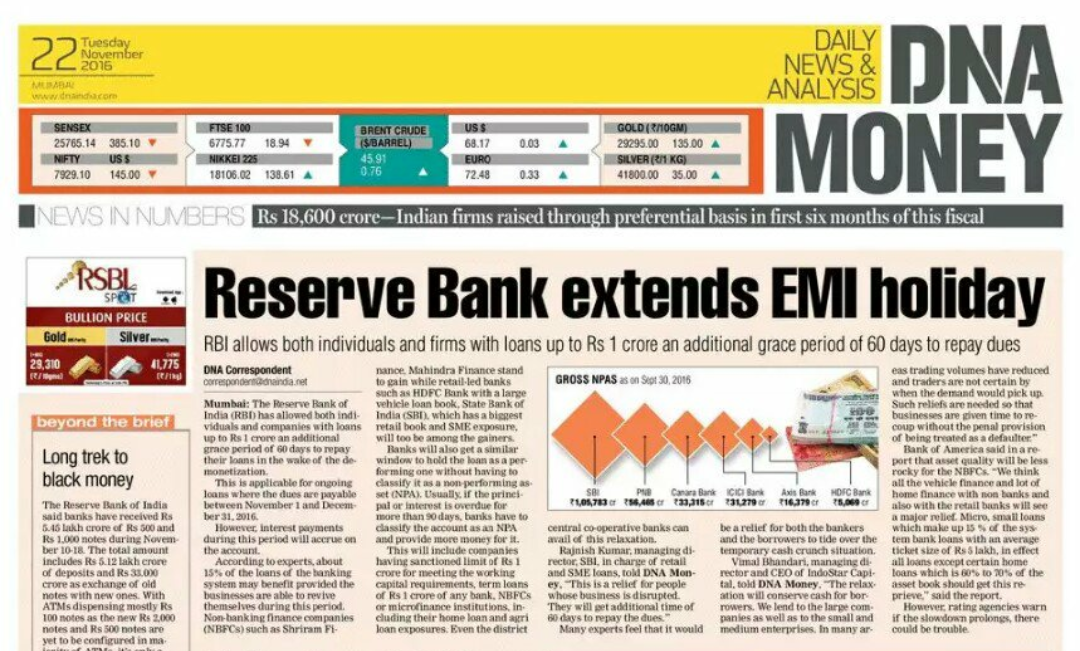
“Reserve Bank extends EMI Holiday” screamed the newspaper early in the morning of 22nd November 2016, amidst those chaotic days of Rs.500 & Rs.1000 "demonetization". “RBI allows both individuals and firms with loans upto Rs. 1 crore an additional grace period of 60 days to repay dues”, said the paper.

...except that there was never any EMI holiday

“Demonetization: RBI gives small borrowers 60 extra days to repay credit”, said another - a leading financial daily, “…small borrowers who have been facing the brunt of demonetization, would get an additional 60 days to repay their credit, including agriculture and housing loans”.

Similar reports were carried by most newspapers that day, and repeated ad nauseum by television channels for several days thereafter. There was however one small problem – the news was completely wrong.
Most media houses wrongly reported the news

What RBI had said

What then had caused the press to report something like this, which wasn’t true at all? The answer to this lay in a circular issued by the Reserve Bank of India, put up on its website the previous day. The circular, titled “Relaxation in Prudential Norms”, said “…it has been decided to provide an additional 60 days beyond what is applicable for the concerned regulated entity(RE) for recognition of a loan account as substandard in the following cases…” and cited a wide gamut of loan accounts where this benefit will be applicable. Read the full circular here.

The operative term here is ‘additional 60 days…for recognition of a loan account as substandard’ which was misinterpreted to mean borrowers getting an extra 60 days to repay their EMIs or other dues. In fact, the RBI circular clearly mentioned “…this is a short-term deferment of classification…” and that this “…does not result in restructuring of the loans”. Shorn of its jargon, this means there is no change in dates when the borrowers have to repay, but if they do not, banks can have an additional 60 days to do what they do when the borrowers do not repay.


Understanding NPAs

News reporters and financial journalists aside, I have seen even analysts tracking the banking sector struggle with these terms. When banks give loans, the loans appear on the asset side of a Balance Sheet. A repayment goes on to reduce that asset, while a fresh disbursement increases these assets. However, not all loans get fully repaid, and occasionally a customer defaults. This leads to a capital loss for the bank, as the assets have to be written off. To an extent, such losses are considered ‘normal’ in the banking business, and prudence requires that banks prepare for them well in advance. This is where ‘provisioning’ comes in.

Provisioning means banks booking an ‘expense’ entry in the Profit & Loss account based on the expected losses arising from such defaults. Provisioning reduces reported profits of the bank and creates a capital buffer, which can be used when the losses actually occur. The amount of provisioning to be done is prescribed by the RBI, and depends on the ‘quality’ of the asset. The worse the quality, higher the provisioning, since lower are the chances you will ever recover your money.

Asset Classification

This is where ‘Asset Classification’ comes in. RBI requires banks to classify all loans in four groups – Standard, Sub-standard, Doubtful and Loss. Initially, all loans start as ‘Standard’. Assets under the other three categories are collectively called “Non-Performing Assets” or NPAs. NPAs are loans where principal or interest has not been received for more than 90 days beyond its due date. The RBI defines ‘Sub-standard’ as an asset which has remained an NPA for a period less than or equal to 12 months. After 12 months as an NPA, the asset degrades to ‘Doubtful’. ‘Loss’ assets are assets where the bank feels there is no hope of recovery from the customer at all. If an EMI was due on 5th February 2017 and the customer failed to pay, the loan would become ‘sub-standard’ on 6th May 2017 (i.e. 90 days after this date). Twelve months after this date i.e. from 6th May 2018 onwards, the loan will be called a ‘Doubtful’ asset.

Note the following peculiarities in this:

1.       A loan does not become an NPA immediately after default. For 90 days, it continues as a ‘Standard’ asset, though conventionally one is inclined to equate 'standard’ assets as those where the customers are repaying on time. Thus, given that demonetization was announced on the evening of 8th November 2016, even an asset due on 9th November and remaining in default would not become an NPA on 31st December 2016. And this even without taking recourse to the extra 60 days provided by the above circular.

2.       There is no hard & fast definition of a ‘Loss’ asset, it is based on a subjective assessment of the bank about the recoverability of the loan. In theory, a loan may continue to be classified as ‘Doubtful’ for several years after default, without ever being moved to ‘Loss’.

Why this classification matters is that the ‘provisioning’ banks are required to do – which, as we saw is an ‘expense’ and hits the bank’s profitability - depend on the category of the loan, progressively increasing as the loan moves down the quality lane from Sub-standard to Doubtful and Doubtful to Loss. RBI even requires banks to make provisioning on Standard assets.

Gross & Net NPAs

When banks declare their financial results, the 'Gross NPA’ and ‘Net NPA’ levels of the bank receive a lot of attention. The summation of assets under the category Sub-standard, Doubtful and Loss – are called the ‘Gross NPA’ of the bank. If you deduct the amount of provisioning done from the Gross NPA, the resultant figure is the ‘Net NPA’ of the bank. But we have seen above that provisioning is an arbitrary number – partly driven by a regulatory minimum, partly driven by the bank’s own discretion. This makes 'Net NPA’ also an arbitrary number. ‘Gross NPA’ however is a much more tangible number – it tells precisely the amount of loans overdue by 90 days or more. There is no subjectivity around it.

The NPA figures are often quoted in terms of percentages. When bank results are declared at the end of every quarter, analysts look at the ratios ‘Gross NPA %’ and ‘Net NPA %’ to determine the quality of bank's assets. Gross NPA % is calculated as ‘Gross NPA of the bank (as described earlier) divided by standard advances plus the gross NPAs’ of the bank i.e. effectively the sum of all loans outstanding as on the date of calculation. Net NPA% is calculated as the ‘Net NPA of the bank (as described earlier) divided by net advances’ i.e. sum of all loans outstanding less the provisioning for NPAs.

Note that only the absolute change in the Gross NPA comes close to showing the true movement of NPAs of the bank. And that too, with the lag of one quarter! That is, Gross NPA as of end-December minus the Gross NPA as of end-September will account for fresh defaults that have taken place in the July to September - and not the October to December - quarter! Net NPAs are distorted by provisioning, and both the ‘percentage ratios’ (Gross NPA% and Net NPA %) are distorted by the denominator. A bank can issue fresh imprudent loans and inflate the denominator, thus showing low NPA%. These fresh loans would become NPAs earliest only in the next quarter because of the 90-day rule.

It’s not over yet. There are write-offs too!

Even difference in Gross non performing assets doesn’t tell the full story of bank’s NPA movement. NPAs are further impacted by the assets “written off” during the period. And this figure may only be available from the Annual Report once a year. Written off assets are reversed completely from the asset book, reducing the Gross NPAs of the bank and the overall asset base itself.

Coming back to RBI circular mentioned earlier, all that the RBI said was that for loans with due dates between 1st November 2016 to 31st December 2016; banks have an extra 60 days – beyond the normal 90 - to recognize them as NPAs. They would become NPAs only if they remain unpaid for 150 days after the due date i.e. between 30th March 2017 to 31st May 2017 respectively, instead of 30th Jan 2017 to 31st March 2017. The asset classification and the amount of provisioning the banks have to do, would be guided accordingly.

As far as the borrowers are concerned, there was no change in their obligations to the bank; their due dates remained the same. There was no “EMI holiday” nor any “extra 60 days” to repay their credit.