Showing posts with label RBI. Show all posts

Sunday, February 26, 2017

Understanding Bank NPAs

“Reserve Bank extends EMI Holiday” screamed the newspaper early in the morning of 22nd November 2016, amidst those chaotic days of Rs.500 & Rs.1000 "demonetization". “RBI allows both individuals and firms with loans upto Rs. 1 crore an additional grace period of 60 days to repay dues”, said the paper.
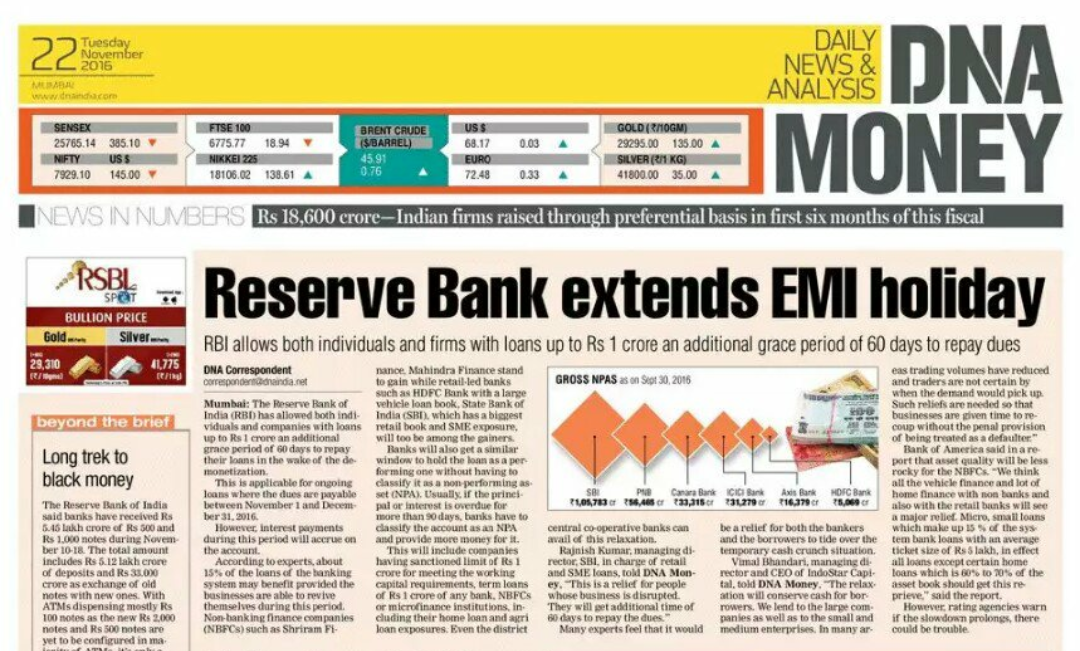
...except that there was never any EMI holiday

“Demonetization: RBI gives small borrowers 60 extra days to repay credit”, said another - a leading financial daily, “…small borrowers who have been facing the brunt of demonetization, would get an additional 60 days to repay their credit, including agriculture and housing loans”.

Similar reports were carried by most newspapers that day, and repeated ad nauseum by television channels for several days thereafter. There was however one small problem – the news was completely wrong.
Most media houses wrongly reported the news

What RBI had said

What then had caused the press to report something like this, which wasn’t true at all? The answer to this lay in a circular issued by the Reserve Bank of India, put up on its website the previous day. The circular, titled “Relaxation in Prudential Norms”, said “…it has been decided to provide an additional 60 days beyond what is applicable for the concerned regulated entity(RE) for recognition of a loan account as substandard in the following cases…” and cited a wide gamut of loan accounts where this benefit will be applicable. Read the full circular here.

The operative term here is ‘additional 60 days…for recognition of a loan account as substandard’ which was misinterpreted to mean borrowers getting an extra 60 days to repay their EMIs or other dues. In fact, the RBI circular clearly mentioned “…this is a short-term deferment of classification…” and that this “…does not result in restructuring of the loans”. Shorn of its jargon, this means there is no change in dates when the borrowers have to repay, but if they do not, banks can have an additional 60 days to do what they do when the borrowers do not repay.


Understanding NPAs

News reporters and financial journalists aside, I have seen even analysts tracking the banking sector struggle with these terms. When banks give loans, the loans appear on the asset side of a Balance Sheet. A repayment goes on to reduce that asset, while a fresh disbursement increases these assets. However, not all loans get fully repaid, and occasionally a customer defaults. This leads to a capital loss for the bank, as the assets have to be written off. To an extent, such losses are considered ‘normal’ in the banking business, and prudence requires that banks prepare for them well in advance. This is where ‘provisioning’ comes in.

Provisioning means banks booking an ‘expense’ entry in the Profit & Loss account based on the expected losses arising from such defaults. Provisioning reduces reported profits of the bank and creates a capital buffer, which can be used when the losses actually occur. The amount of provisioning to be done is prescribed by the RBI, and depends on the ‘quality’ of the asset. The worse the quality, higher the provisioning, since lower are the chances you will ever recover your money.

Asset Classification

This is where ‘Asset Classification’ comes in. RBI requires banks to classify all loans in four groups – Standard, Sub-standard, Doubtful and Loss. Initially, all loans start as ‘Standard’. Assets under the other three categories are collectively called “Non-Performing Assets” or NPAs. NPAs are loans where principal or interest has not been received for more than 90 days beyond its due date. The RBI defines ‘Sub-standard’ as an asset which has remained an NPA for a period less than or equal to 12 months. After 12 months as an NPA, the asset degrades to ‘Doubtful’. ‘Loss’ assets are assets where the bank feels there is no hope of recovery from the customer at all. If an EMI was due on 5th February 2017 and the customer failed to pay, the loan would become ‘sub-standard’ on 6th May 2017 (i.e. 90 days after this date). Twelve months after this date i.e. from 6th May 2018 onwards, the loan will be called a ‘Doubtful’ asset.

Note the following peculiarities in this:

1.       A loan does not become an NPA immediately after default. For 90 days, it continues as a ‘Standard’ asset, though conventionally one is inclined to equate 'standard’ assets as those where the customers are repaying on time. Thus, given that demonetization was announced on the evening of 8th November 2016, even an asset due on 9th November and remaining in default would not become an NPA on 31st December 2016. And this even without taking recourse to the extra 60 days provided by the above circular.

2.       There is no hard & fast definition of a ‘Loss’ asset, it is based on a subjective assessment of the bank about the recoverability of the loan. In theory, a loan may continue to be classified as ‘Doubtful’ for several years after default, without ever being moved to ‘Loss’.

Why this classification matters is that the ‘provisioning’ banks are required to do – which, as we saw is an ‘expense’ and hits the bank’s profitability - depend on the category of the loan, progressively increasing as the loan moves down the quality lane from Sub-standard to Doubtful and Doubtful to Loss. RBI even requires banks to make provisioning on Standard assets.

Gross & Net NPAs

When banks declare their financial results, the 'Gross NPA’ and ‘Net NPA’ levels of the bank receive a lot of attention. The summation of assets under the category Sub-standard, Doubtful and Loss – are called the ‘Gross NPA’ of the bank. If you deduct the amount of provisioning done from the Gross NPA, the resultant figure is the ‘Net NPA’ of the bank. But we have seen above that provisioning is an arbitrary number – partly driven by a regulatory minimum, partly driven by the bank’s own discretion. This makes 'Net NPA’ also an arbitrary number. ‘Gross NPA’ however is a much more tangible number – it tells precisely the amount of loans overdue by 90 days or more. There is no subjectivity around it.

The NPA figures are often quoted in terms of percentages. When bank results are declared at the end of every quarter, analysts look at the ratios ‘Gross NPA %’ and ‘Net NPA %’ to determine the quality of bank's assets. Gross NPA % is calculated as ‘Gross NPA of the bank (as described earlier) divided by standard advances plus the gross NPAs’ of the bank i.e. effectively the sum of all loans outstanding as on the date of calculation. Net NPA% is calculated as the ‘Net NPA of the bank (as described earlier) divided by net advances’ i.e. sum of all loans outstanding less the provisioning for NPAs.

Note that only the absolute change in the Gross NPA comes close to showing the true movement of NPAs of the bank. And that too, with the lag of one quarter! That is, Gross NPA as of end-December minus the Gross NPA as of end-September will account for fresh defaults that have taken place in the July to September - and not the October to December - quarter! Net NPAs are distorted by provisioning, and both the ‘percentage ratios’ (Gross NPA% and Net NPA %) are distorted by the denominator. A bank can issue fresh imprudent loans and inflate the denominator, thus showing low NPA%. These fresh loans would become NPAs earliest only in the next quarter because of the 90-day rule.

It’s not over yet. There are write-offs too!

Even difference in Gross non performing assets doesn’t tell the full story of bank’s NPA movement. NPAs are further impacted by the assets “written off” during the period. And this figure may only be available from the Annual Report once a year. Written off assets are reversed completely from the asset book, reducing the Gross NPAs of the bank and the overall asset base itself.

Coming back to RBI circular mentioned earlier, all that the RBI said was that for loans with due dates between 1st November 2016 to 31st December 2016; banks have an extra 60 days – beyond the normal 90 - to recognize them as NPAs. They would become NPAs only if they remain unpaid for 150 days after the due date i.e. between 30th March 2017 to 31st May 2017 respectively, instead of 30th Jan 2017 to 31st March 2017. The asset classification and the amount of provisioning the banks have to do, would be guided accordingly.

As far as the borrowers are concerned, there was no change in their obligations to the bank; their due dates remained the same. There was no “EMI holiday” nor any “extra 60 days” to repay their credit.

Tuesday, August 27, 2013

A bridge to nowhere

The Preamble of the Reserve Bank of India describes the basic functions of the Reserve Bank as "...to regulate the issue of Bank Notes and keeping of reserves with a view to securing monetary stability in India and generally to operate the currency and credit system of the country to its advantage." The central bank, of course has other functions in addition to this, such as the manager of foreign exchange, acting as the banker to the government and a lender of the last resort to the banking system. Maintaining price stability however, has always been seen as the primary objective of any Central Bank in the world. As the incumbent Governor of the Reserve Bank Dr. D. Subbarao prepares to demit office after an eventful tenure, I took a look at his monetary policy actions and the impact they have had on some key indicators in the country.

Subbarao’s tenure at the Reserve Bank has been one of the most challenging of any RBI Governor’s in recent times. Within days of his taking office, financial crises struck the economies of the West. Giant institutions collapsed.  Credit markets froze. World trade came almost to a halt. Stock markets crashed. Commodities plunged. The recession that followed in the U.S. and Europe has been described as the worst since the Great Depression of 1932. Though not a direct party to the tumultuous events unfolding in the developed world, a rub-off effect on India was inevitable.

Subbarao’s tenure has also coincided with a leadership crisis at the centre in New Delhi. In the last few years, a profligate UPA-II sunk itself neck deep in corruption, mega scams hit the headlines, crony capitalism peaked, “policy paralysis” became the buzzword and economic reforms that started in the 1990s reversed, ironically by the same man who was hailed as the architect of those reforms earlier. A welfare state has emerged.

In such an environment, managing the country's monetary policy can be no easy task. The policy under Subbarao followed alternate bouts of easing and tightening liquidity in 'baby steps' of 0.25 to 0.50 percent each at intervals of a few months at a time.


Phase
Over a period
Action
Eased liquidity, lowered rates
Oct 08 – Feb 10
Reduced CRR by 4 %
Reduced Repo by 4.25 %, Reverse Repo rate by 2.75 %
Squeezed liquidity, raised rates
Feb 10 – Jan 12
Raised CRR by 1 %
Raised Repo, Reverse Repo rate by 3.50 %
Eased liquidity, lowered rates
Jan 12 – May 13
Reduced CRR by 2%
Reduced Repo, Reverse Repo rate by 1.25 %

What effect, if any, have these steps had on the key indicators stated while embarking on these policy actions? Let us take a look at some of them


Consumer prices have risen more than 50 % in less than five years
Consumer prices have risen continuously, at almost a uniform rate in the last five years. Between October 2008 and June 2013, prices (as indicated by CPI-IW) are up more than 50 % i.e. more than ten percent per annum compounded. Whether Subbarao was tightening credit or easing liquidity, it has clearly had little impact on consumer prices. 


The Rupee has depreciated from Rs. 48 to a $ to Rs. 65 in less than 5 years 
After an initial period of stability, the currency has collapsed. Especially from August 2011 when it was trading at Rs.45, it has been a one way street for the Indian Rupee, trading at around Rs. 65 to a dollar at the time of this writing. It is instructive to note that the Rupee broke its long term trading range (between Rs.45 to 50) in end-2011, when it was clear that the tightening cycle has ended and rates would be lowered going forward. Subbarao reversed the rate cycle with a CRR cut in January 2012.


Industrial production has gone nowhere in the last three years
If the rationale for cutting interest rates starting January 2012 was to promote industrial growth, it has clearly not worked. The Index of Industrial Production has gone nowhere in the last three and a half years - it stood at 163.60 in January 2010 and stands at 164.3 in June 2013. Whether Subbarao was raising rates or lowering them, industry has stagnated. 

In retrospect, vacillating between the demand from industry for lower interest rates and the imperative to tame inflation, monetary policy went nowhere under Subbarao. The cycle of liquidity tightening was abandoned abruptly in January 2012, ostensibly under the pretext of taming inflation. But even the meager mitigation in wholesale inflation rate never reached the end consumers. By lowering interest rates too early, Subbarao clearly jumped the gun, aiding, if not entirely causing the currency collapse. 

A prolonged period of negative interest rates is the primary cause of India’s financial crisis today. Negative interest rates promote investment in hard assets like gold and real estate at the cost of financial assets. Negative interest rates induce excessive borrowing and investment in unviable projects. Negative interest rates cause a flight of capital and depreciate the currency. The high inflation in recent years, and the sharp depreciation of the Rupee is a direct consequence of the RBI’s reluctance to raise rates when the situation demanded. A hawkish RBI is necessary to counter government profligacy.

Ironically, and unfortunately, Subbarao has been blamed for precisely the opposite – for not lowering rates enough. In the media, he is often portrayed as the one taking on the mandarins of the North Block, on issues ranging from interest rates reduction to new bank licences. But the symptoms of the current crisis - high inflation and a depreciating currency - prove that interest rates need to be higher and not lower than what they are. Subbarao probably knew this, but in the wake of the misleading clamor for reducing rates from the industry, politicians, influential economists and the media, could not stand up to his beliefs with conviction. In the end, his policy actions could neither control inflation nor promote growth.

Subbarao took office in the midst of a global crisis. He is now leaving in the midst of a domestic one.

(Also read a related article here)

Wednesday, January 23, 2013

Why RBI needs to RAISE interest rates


On 16th January 2013, speaking at an outreach programme of the Reserve Bank of India (RBI) at Lalpur Karauta village in the state of Uttar Pradesh, India, Governor Dr. D. Subbarao said this: "If you see the currency note, it is printed on it that 'I promise to pay the bearer the sum of Rs 100' and it has my signature as the RBI Governor. What does the promise and signature mean? It means that the RBI will control inflation and maintain its purchasing power". It is another matter that the stream of journalists present did not report this very important statement (see here, for example) when they filed their reports on the event. Either they did not really understand what the Governor said, or did not like what they heard.

If you read the pink press regularly, or watch one of those stock market channels masquerading as ‘business’ channels, you might be forgiven to think that the RBI Governor sits in his office holding a magic wand in his hand. All he needs to do is to waive the wand lower, and lo! All the country’s economic problems would be solved! This magic wand, the press might tell you, is called The Interest Rate. So much is the pressure from interested politicians, crony capitalists and the media on the Central Bank to reduce rates, that one would be inclined to believe that that’s all that is there to managing an economy.

Subbarao has a promise to keep - to maintain the purchasing power of our money

The truth however, is not so simple. When it comes to the interest rates, the mainstream media is not just wrong, it is preaching exactly the opposite. Let us therefore be clear – beginning to reduce interest rates right now will take the country on the path of ruin.

Let us understand why I am saying interest rates need to be raised.

Inflation is still running frighteningly high. As per the latest figures, Consumer Price inflation (CPI) is at 10.56 % per annum. Food prices have increased by 13.04 %, with several key ingredients such as oils & fats (16.73 %), vegetables (25.71 %), sugar (13.55 %) rising at a much faster pace. Being official figures, even these figures may be grossly understated. Prices of several items have as much as doubled in the past year. The index does not even include the dramatic increase in the prices of services like transport  and education.

Bank lending is already growing faster than deposits. For deposits to catch up, interest rates need to be raised. RBI has pointed this out in the last mid-quarter monetary policy review on 18th December 2012. In December, borrowings from RBI’s LAF (Liquidity Adjustment Facility) reached highest level for the year at Rs.1.70 lakh crore and are still running high at almost Rs. 80,000 - 1 lakh crore this month (see this or  this). To put it simply, banks as a whole are lending more than what their deposit base justifies.

The high rate of inflation and the shortage of deposits with banks clearly point to a need to raise, and not lower interest rates. Even the slight dip in wholesale inflation rate (WPI) from 7.24 % to 7.18 % that is being bandied around is far higher than RBI's 'comfort level' of 4 - 5 %.

Lowering interest rates ignores the interests of savers completely; it presupposes that borrowers are the only ones interested in interest rates. Lowering interest rates punishes savers, rewards borrowers and encourages profligacy. An economy should be built on solid foundations of high savings rate, and not on high borrowings. If savings are high, plenty of money will be available for productive investment, and this in turn will cause rates to move lower. Low interest rates are thus an outcome of a healthy economy, lowering rates artificially cannot automatically lead to a healthy economy.

In its Financial Stability Report released last month, the RBI has stated that low real interest rates are causing diversion of savings to hard assets like property and gold. Lowering rates further will worsen this trend.

Raising rates strengthens the currency, something India badly needs to do. India’s foreign exchange problems are well known and need not be elaborated here.  At a time when the country is trying to attract foreign capital by opening up new sectors for foreign investment, what justifies discouraging domestic savings?

Lowering interest rates now will worsen these trends, causing a further rise in inflation, erosion of savings, flight of deposits from the banking system and weakening the currency.

Vested interest and sheer ignorance promotes the myth that somehow low interest rates are  ‘good’ and high rates ‘evil’. The debate in the mainstream media is so one-sided that the merits of raising the rates or keeping them high are not even discussed. The bogey of low industrial growth and high Non-Performing Assets (NPAs) is raised every time to oppose raising or justify lowering the rates. But industrial growth has been slow mainly because inflation is eating away into people’s savings, leaving people with little money to spend on other things. High NPAs have been a result of various factors like the policy mess (e.g. power sector), poor business plans (e.g. aviation) or simply, in the words of the Finance Minister himself, “poor lending decisions”, not to mention willful defaults and corruption (e.g. real estate). I have not come across any instance which points to high interest rates as the primary cause of an asset turning bad. The rates simply aren’t that high.  

If high interest rates are not a cause of the problem, lowering them cannot be the solution as well.

The villagers of Lalpur Karuata, like the rest of us, will soon know whether Subbarao keeps his promise.